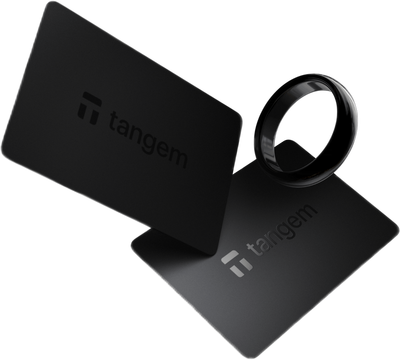
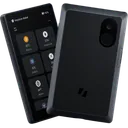
World's first smart ring hardware wallet at $160, using the same EAL6+ Samsung secure element as Tangem cards in a waterproof titanium form factor requiring no charging.
The Tangem Ring is a genuinely novel hardware wallet that trades screen-based verification for wearable convenience, making it a mixed proposition depending on your threat model. Its EAL6+ Samsung secure element, passive NFC, IP69K rating, and 25-year chip lifespan deliver serious security in a battery-free titanium form factor. No backup ring is included at $160, no display for transaction verification, and no desktop support — skip it if blind signing is a dealbreaker for you.
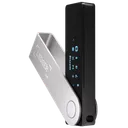
The Tangem Ring uses the same Samsung S3B512C secure element certified at EAL6+ — the highest certification level found in any consumer hardware wallet currently on the market. For context, the Ledger Nano X uses an ST33K1M5 at EAL5+, and the Trezor Safe 3 uses an Infineon SLx9670 at EAL6+, making the Tangem Ring competitive at the top tier of secure element certification.
The firmware is not open source, which is a meaningful limitation. Tangem publishes the application-layer code on GitHub, but the firmware running on the secure element itself remains closed. Reproducible builds are therefore not possible for independent verification. Firmware updates are signed by Tangem — the specific signing key infrastructure is not publicly documented.
Genuine device verification is supported: the ring performs a cryptographic attestation handshake via NFC on first pairing, confirming the secure element's authenticity against Tangem's certificate chain. This is a real supply-chain protection mechanism, not just a holographic sticker.
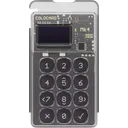
Secure boot is implemented at the hardware level within the Samsung chip. No publicly disclosed exploits or hardware attacks specific to the Tangem Ring exist as of this writing. However, the passive NFC attack surface is a structural concern — any NFC-capable device within range during a transaction could theoretically attempt relay attacks. Tangem's implementation requires physical proximity and app-side confirmation, which mitigates but does not eliminate this vector. Compared to the ColdCard Mk4, which is air-gapped with PSBT-over-SD, the Ring's NFC-only connectivity is a broader attack surface by design.
SecurityKey Factor
The Tangem Ring supports two recovery paths: Tangem's proprietary "Smart Backup" system and a standard BIP39 24-word seed phrase. By default, Tangem encourages the Smart Backup approach, which distributes key shards across multiple Tangem devices — but the Ring ships as a single device with no backup ring included. Purchasing a second ring at $160 for backup purposes is the vendor's recommendation, bringing the effective entry cost to $320.
Passphrase support (BIP39 25th word) is available, enabling hidden wallet functionality. Shamir Secret Sharing (SLIP39) is not supported, which puts it behind the Trezor Model T and Safe 3 in backup flexibility.
If the ring is lost or damaged without a backup device, recovery depends entirely on whether the user exported their seed phrase during setup — a step that Tangem's default flow does not emphasize. This is a genuine risk for non-technical users who follow the app's guided setup without opting into seed export. The recovery process on a new Tangem device using the seed phrase is straightforward, but restoring to a non-Tangem wallet requires manually importing the 24-word phrase into compatible software.
Compared to the Foundation Passport, which generates a seed phrase by default and treats it as the primary backup, Tangem's seed-optional approach places more responsibility on the user to actively choose the more recoverable path. This is a design philosophy difference with real-world consequences for average users.
Recovery & backups
The Tangem Ring has no screen, no buttons, and no battery. All interaction happens through the companion app (iOS and Android) via NFC tap. Setup takes approximately 3–5 minutes: install the app, tap the ring to pair, set a PIN within the app, and optionally back up the seed phrase. There are no firmware updates to install, no cable connections, and no seed phrase to write down unless the user opts in.
Daily use is as simple as opening the Tangem app, initiating a transaction, and tapping the ring to the phone to sign. The absence of a screen means transaction details are displayed only on the phone — users must trust their mobile device's display for address verification. This is a significant security UX trade-off compared to devices like the Ledger Nano X (0.96" OLED) or Keystone 3 Pro (4" touchscreen), both of which display addresses on the hardware device itself for independent verification.
The companion app supports iOS and Android only — no desktop support for Linux, Windows, or macOS. The app UI is clean and consumer-focused, with WalletConnect integration for DeFi access. The learning curve is minimal for mobile-first users; experienced hardware wallet users accustomed to screen-based verification may find the screenless design uncomfortable from a security standpoint.
The wearable form factor is genuinely novel — the ring is always on hand, eliminating the need to carry a separate device. For users who prioritize convenience and already trust their smartphone, this is a meaningful UX advantage over any card or USB-based wallet.
Usability / UX
The Tangem Ring supports 85 blockchain networks and over 6,000 tokens through the Tangem app. Key L1 chains include Bitcoin, Ethereum, Solana, BNB Chain, Polygon, Avalanche, and Tron. EVM-compatible chains are broadly covered.
Third-party wallet compatibility is limited. The Tangem Ring does not natively integrate with Sparrow Wallet, Electrum, or MetaMask browser extension — it relies on the proprietary Tangem app for all transaction signing. WalletConnect v2 is supported within the Tangem app, enabling access to DeFi protocols and NFT platforms on compatible chains. This is functional but less flexible than the Ledger Nano X, which connects directly to MetaMask, Rabby, and dozens of third-party interfaces via USB or Bluetooth without requiring the Ledger Live app as intermediary.
Multisig support is described as "basic" — Tangem's multi-device backup scheme functions as a form of multisig, but standard Bitcoin multisig via PSBT with external coordinators like Sparrow is not supported. This is a hard limitation for users building collaborative custody setups. CoinJoin is not supported.Offline signing is supported in the sense that the ring itself is air-gapped from the internet, but transaction construction and broadcast require the connected mobile app.
Ecosystem & integrations
The Tangem app does not require account registration or email submission to use the Ring — pairing is device-local. This is a meaningful baseline privacy protection compared to wallets that require KYC or account creation.
Telemetry behavior in the Tangem app is not fully documented in their public privacy policy. Whether analytics are collected by default and whether opt-out is available is not independently verified. The app connects to Tangem's backend infrastructure for blockchain node queries, meaning transaction metadata (addresses, timing) is visible to Tangem's servers unless the user routes traffic through a VPN or Tor. Custom node configuration is supported in the Tangem app, which allows privacy-conscious users to point queries at their own node — a meaningful feature.
The Ring cannot operate fully offline; the companion app requires internet access to broadcast transactions and query balances. CoinJoin is not supported, which is a hard gap compared to ColdCard Mk4 (Whirlpool-compatible via Sparrow) and Foundation Passport (Sparrow integration with full PSBT support). For Bitcoin privacy specifically, the Tangem Ring is a weak option. For users whose primary concern is convenient multi-chain access rather than Bitcoin privacy, the lack of mandatory registration is a reasonable starting point.
Privacy
The Tangem Ring retails at $160 USD for a single device. Tangem explicitly recommends purchasing two for backup redundancy, bringing the realistic cost to $320. At that price point, it competes directly with the Ledger Nano X at $149, the Foundation Passport at $199, and the Keystone 3 Pro at $169 — all of which include screens for independent transaction verification and broader third-party wallet compatibility.
The titanium and zirconia ceramic construction, IP69K water resistance rating, passive NFC (no charging ever required), and 25-year chip lifespan guarantee are genuine differentiators. No other hardware wallet on the market offers a wearable ring form factor. For users who want a device that is always physically present without carrying anything extra, the Ring occupies a unique position.
The value case is strongest for mobile-first users who hold diversified multi-chain portfolios and prioritize convenience over advanced security controls. It is weakest for Bitcoin-only users who need CoinJoin, PSBT-based multisig, or Sparrow compatibility — for whom a ColdCard Mk4 at $149.99 or a Passport at $199 delivers far more relevant capability per dollar.
Users who need desktop wallet integration (Linux, Windows, macOS) should look elsewhere — the Ring has zero desktop support. At $160 for a single unit with no backup included, the price-to-capability ratio is acceptable only if the wearable form factor is a genuine priority rather than a novelty.
Price & value
The Tangem Ring is a genuinely innovative piece of wearable crypto hardware that earns its place as a conversation-starting daily driver, but its form-factor novelty comes with real trade-offs that demand careful consideration before you spend $160.
Buy this wallet if you are a crypto-native who values seamless, always-on access — the passive NFC design means no charging, no cables, and a tap-to-sign experience that genuinely fits into daily life without friction.
Buy this wallet if you already trust the Tangem ecosystem — the EAL6+ Samsung secure element is the same chip powering Tangem's card lineup, so you get proven security in a radically different shell.
Buy this wallet if physical durability matters to you — IP69K water resistance, zirconia ceramic construction, and a 25-year chip lifespan guarantee make this one of the most physically resilient signing devices available at any price.
Skip this wallet if you need a backup device included out of the box — unlike the Tangem Card 3-pack (around $69), the Ring ships as a single unit with no backup ring; losing or damaging it without a second device is a serious recovery risk. Consider the Tangem Card bundle instead.
Skip this wallet if you manage large, complex portfolios requiring desktop software — there is no Windows, macOS, or Linux support, and multisig is only basic. The Ledger Flex ($249) or Coldcard Mk4 ($149) offer far deeper desktop integration for power users.
Skip this wallet if open firmware is a non-negotiable requirement — the firmware remains closed-source, which is a meaningful concern for the most security-conscious holders; the Foundation Passport ($199) is a better fit there.
If choosing between the Tangem Ring ($160) and the Tangem Card 3-pack ($69): the cards win on value and built-in redundancy — the Ring is a lifestyle upgrade, not a security upgrade. If choosing between the Tangem Ring ($160) and the Ledger Nano X ($149): the Nano X supports Bluetooth, desktop apps, and a broader software ecosystem; the Ring wins on durability and wearability but loses on versatility.
Our rating reflects a device that executes its narrow mission with impressive engineering, but the closed firmware, single-device packaging, and mobile-only connectivity keep it from reaching the top tier. Check the score above to see exactly where the Tangem Ring lands in our rankings.
✓ Our Verdict
The Tangem Ring is a genuinely innovative piece of wearable crypto hardware that earns its place as a conversation-starting daily driver, but its form-factor novelty comes with real trade-offs that demand careful consideration before you spend $160.
Buy this wallet if you are a crypto-native who values seamless, always-on access — the passive NFC design means no charging, no cables, and a tap-to-sign experience that genuinely fits into daily life without friction.
Buy this wallet if you already trust the Tangem ecosystem — the EAL6+ Samsung secure element is the same chip powering Tangem's card lineup, so you get proven security in a radically different shell.
Buy this wallet if physical durability matters to you — IP69K water resistance, zirconia ceramic construction, and a 25-year chip lifespan guarantee make this one of the most physically resilient signing devices available at any price.
Skip this wallet if you need a backup device included out of the box — unlike the Tangem Card 3-pack (around $69), the Ring ships as a single unit with no backup ring; losing or damaging it without a second device is a serious recovery risk. Consider the Tangem Card bundle instead.
Skip this wallet if you manage large, complex portfolios requiring desktop software — there is no Windows, macOS, or Linux support, and multisig is only basic. The Ledger Flex ($249) or Coldcard Mk4 ($149) offer far deeper desktop integration for power users.
Skip this wallet if open firmware is a non-negotiable requirement — the firmware remains closed-source, which is a meaningful concern for the most security-conscious holders; the Foundation Passport ($199) is a better fit there.
If choosing between the Tangem Ring ($160) and the Tangem Card 3-pack ($69): the cards win on value and built-in redundancy — the Ring is a lifestyle upgrade, not a security upgrade. If choosing between the Tangem Ring ($160) and the Ledger Nano X ($149): the Nano X supports Bluetooth, desktop apps, and a broader software ecosystem; the Ring wins on durability and wearability but loses on versatility.
Our rating reflects a device that executes its narrow mission with impressive engineering, but the closed firmware, single-device packaging, and mobile-only connectivity keep it from reaching the top tier. Check the score above to see exactly where the Tangem Ring lands in our rankings.
Ready to buyTangem Ring?
We may earn a commission if you purchase through our links. This doesn't affect our editorial independence.
Impermanent loss happens when asset prices in a liquidity pool diverge from external markets, reducing the value of liquidity providers' holdings compared to simply holding the assets.
Tangem is a hardware wallet in the form of a physical card that stores cryptocurrency private keys securely and offline, allowing for easy and portable access to digital assets.
EAL Certification (Evaluation Assurance Level) from Common Criteria rates the security of hardware components, like secure chips in crypto hardware wallets. Higher levels, such as EAL5+ or EAL6+, indicate stronger resistance to attacks.
Reproducible Builds refer to the process where the same source code consistently produces identical binary outputs, ensuring verifiable and trustworthy software in blockchain and crypto projects.
Firmware Attestation is the process of verifying the authenticity of a device's firmware to ensure it has not been tampered with, commonly used in hardware wallets for security.
Secure Boot is a security feature that ensures only trusted software runs on a device by verifying its integrity during startup, preventing unauthorized code execution in crypto systems.
A block confirmation is the process of verifying a new block in the blockchain network, confirming its validity and preventing double-spending or fraud.
PSBT (Partially Signed Bitcoin Transaction) is a Bitcoin transaction format that allows multiple parties to sign a transaction incrementally before finalizing it.
Recovery is the process of restoring access to a cryptocurrency wallet using its seed phrase or mnemonic backup if the original wallet is lost or inaccessible.
A backup in cryptocurrency is a secure copy of a wallet's seed phrase or private keys. It enables recovery of funds if the original wallet is lost or damaged.
BIP39 is a standard for generating mnemonic seed phrases that are used to create deterministic wallets and securely back up cryptocurrency private keys.
A passphrase is an additional security layer for cryptocurrency wallets, acting as a 25th word in the BIP39 seed phrase, protecting access to hidden wallets.
A hidden wallet conceals a secondary cryptocurrency wallet behind an additional passphrase on the same seed, providing plausible deniability against coercion.
Shamir Secret Sharing (SSS) divides a secret, like a crypto wallet seed, into multiple shares. A threshold number of shares reconstructs it, enhancing security as in SLIP-39 backups.
A companion app is a software application used to manage and interact with cryptocurrency wallets or blockchain networks, typically offering features like transactions and security controls.
Address Verification confirms the receiving address shown on a hardware wallet's screen matches the one on the computer or app, preventing malware from altering it.
WalletConnect is a protocol that enables secure communication between decentralized applications (dApps) and mobile wallets through QR code scanning or deep linking.
DeFi (Decentralized Finance) refers to a set of financial services, such as lending and trading, built on blockchain technology without traditional intermediaries like banks.
Bitcoin (BTC) is the first decentralized cryptocurrency, launched in 2009. It uses blockchain technology for secure, peer-to-peer digital transactions without intermediaries.
Ethereum is a decentralized blockchain platform that enables smart contracts and decentralized applications (dApps). Its native cryptocurrency is Ether (ETH).
Solana is a high-performance layer-1 blockchain platform that enables fast, low-cost transactions using Proof of History and Proof of Stake. Its native token is SOL.
BNB Chain is a high-performance blockchain network developed by Binance, formerly Binance Smart Chain (BSC). It supports smart contracts, DeFi, and uses BNB as its native token.
Polygon is a layer-2 scaling solution for Ethereum that enables faster, cheaper transactions via its Proof-of-Stake sidechain. Native token: MATIC (also called Polygon PoS).
Avalanche (AVAX) is a scalable layer-1 blockchain platform that achieves high throughput and sub-second transaction finality using its novel proof-of-stake consensus.
TRON is a blockchain platform and cryptocurrency (TRX) designed for high-throughput decentralized applications, especially in content sharing and entertainment.
Electrum is a lightweight Bitcoin wallet that allows users to store, send, and receive Bitcoin securely. It is known for its speed and low resource usage.
An NFT (Non-Fungible Token) is a unique digital asset stored on a blockchain, representing ownership of a specific item, such as artwork, music, or virtual goods.
Ledger Live is a software application that manages cryptocurrency assets and interacts with Ledger hardware wallets for secure transactions and portfolio management.
Multisig (multi-signature) is a security feature that requires multiple private keys to authorize a transaction, enhancing protection against unauthorized access in blockchain networks.
CoinJoin is a privacy technique in cryptocurrency where multiple users combine their transactions, making it harder to trace individual senders and receivers.
Offline Signing refers to signing cryptocurrency transactions on a device that is not connected to the internet, ensuring private keys remain secure from online threats.
KYC (Know Your Customer) is the regulatory process where cryptocurrency exchanges verify users' identities using documents like ID or proof of address to prevent fraud and money laundering.
Telemetry in cryptocurrency and blockchain refers to the automatic collection and transmission of anonymous usage data, metrics, and error reports from wallets or nodes to improve software.
IP Rating refers to the level of protection a device has against dust and water, often used for hardware wallets to indicate their durability in various environments.
HODL is cryptocurrency slang for holding assets long-term despite price volatility, rather than selling. It originated from a 2013 forum post misspelling 'hold' as 'I AM HODLING.'
Cryptocurrency is a digital or virtual currency secured by cryptography, operating on decentralized blockchain networks to enable secure, peer-to-peer transactions.
NFC Connectivity in cryptocurrency enables contactless transactions using near-field communication, allowing users to sign or authorize actions by tapping their device to a reader.
Open Source Firmware refers to firmware in hardware devices, like wallets, where the source code is publicly available, allowing transparency, auditability, and customization.
Tangem Ring uses a certified Secure Element chip to store private keys in tamper-resistant hardware. Even if the device's software were compromised, the Secure Element isolates your keys from extraction. The firmware is open-source, meaning security researchers worldwide can audit the code for vulnerabilities. The device has been independently security audited.
What if Tangem goes out of business?
Tangem's firmware is open-source — even if the company disappears, the community can maintain the software. Your seed phrase works with any BIP39-compatible wallet, so your funds are always recoverable.
What if I lose my Tangem Ring?
Your cryptocurrency is stored on the blockchain, not on the device. If you lose your Tangem Ring, you can recover full access using your seed phrase on any compatible wallet. Multiple backup cards are supported for redundant recovery.
How long will Tangem Ring receive security updates?
Tangem actively maintains Tangem Ring with regular firmware updates.
Is the Tangem Ring safe to use as a hardware wallet?
Yes. The Tangem Ring uses the same EAL6+ certified Samsung secure element found in Tangem's card wallets — one of the highest security certifications available for embedded chips. Private keys are generated and stored entirely on the chip and never leave the device. The ring also features secure boot and genuine-check verification to prevent tampering. Its passive NFC design means there is no wireless radio that can be remotely exploited. The main safety caveat: no backup ring is included, so losing the ring without a seed phrase backup means losing access to your funds.
Is the Tangem Ring worth it compared to the Tangem Card?
The Tangem Ring and Tangem Card share identical security hardware, so the choice is about form factor and price. The ring costs around $160 versus roughly $50–$70 for a 3-card Tangem set. What you pay for is wearability — the ring is always on your finger, made from zirconia ceramic with titanium construction, and rated IP69K waterproof. If you want a discreet, always-available signing device and don't mind the premium, it's worth it. If you prioritize built-in backup redundancy, the 3-card Tangem set offers better value out of the box.
How do you set up the Tangem Ring and what coins does it support?
Setup takes under two minutes using the Tangem mobile app (iOS and Android). Simply tap the ring to your NFC-enabled phone and follow the on-screen prompts to generate your wallet. No cables, no computer, no charging required. The ring supports over 85 blockchain networks and more than 6,000 tokens, including Bitcoin, Ethereum, Solana, and most major EVM chains. It is compatible with BIP39 24-word seed phrases and supports passphrases for additional security. Offline transaction signing is handled entirely on the chip during the NFC tap.
What are the known concerns or risks with the Tangem Ring?
The most significant concern is backup strategy. The Tangem Ring is sold as a single device with no companion backup ring included. If lost or damaged without a recorded seed phrase, funds are unrecoverable. Tangem's firmware is also not fully open source, which limits independent security auditing of the on-chip code. Additionally, the ring has no display, so you cannot verify transaction details on the device itself — you rely entirely on your phone screen. Users with larger fingers should also verify sizing carefully, as the available range is US 6–13.
Is the Tangem Ring price of $160 justified?
At $160, the Tangem Ring is priced as a premium wearable rather than a standard hardware wallet. You are paying for the zirconia ceramic and titanium build, the wearable form factor, and the IP69K water resistance — not for extra security features over cheaper alternatives. The underlying chip security is the same as in much less expensive Tangem cards. For users who value having their wallet physically on them at all times and appreciate the discreet design, the price is reasonable. For pure security-per-dollar, other hardware wallets offer comparable or stronger protection at lower cost.
Does the Tangem Ring work without a battery or charging?
Yes. The Tangem Ring requires no battery and no charging. It operates entirely through passive NFC, drawing the tiny amount of power needed to communicate directly from your smartphone's NFC field during a tap. This means the ring will never run out of power and has no charging port that could fail or corrode. Tangem guarantees the embedded secure chip has a 25-year operational lifespan. This passive design also contributes to the ring's slim profile and full waterproofing, since there are no openings required for charging.
Can the Tangem Ring be used for everyday crypto payments?
Yes, this is one of its core use cases. The Tangem Ring is designed to be payment-ready — you tap the ring to your NFC-enabled phone to sign and broadcast transactions directly from the Tangem app. It supports iOS and Android devices with NFC. Because it is worn on your finger and requires no setup time, it is more convenient for frequent use than traditional hardware wallets that require cables or Bluetooth pairing. However, keep in mind there is no on-device display, so transaction details must always be verified on your phone before signing.
Some links on this page are affiliate links. If you purchase through them, I may earn a commission at no additional cost to you. This helps support the site and allows me to continue creating detailed, independent reviews.
Our testing methodology is evolving. Ratings and assessments will be refined as we improve our scoring framework to reflect the most accurate results.
Ready to get Tangem Ring?
Long-term support • Secure Element • Security audited • NFC • Open source