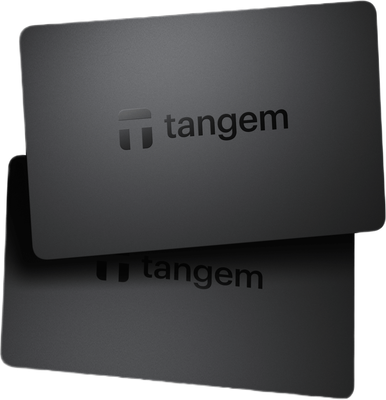
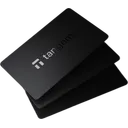
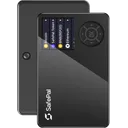
Cardless hardware wallet using NFC-enabled cards with a proprietary secure element, supporting 85 networks at $54 for a 2-card backup set. Closed-source firmware limits independent security verification.
Tangem (2 cards) is a mixed proposition: ultra-portable at 6g and 1mm thick with a CC EAL6+ Samsung secure element, but significant security trade-offs exist. NFC-only tap-to-sign across 85 networks with no seed phrase by default makes onboarding frictionless. Closed-source firmware with no reproducible builds and no display for transaction verification make it unsuitable for users who prioritize auditability or advanced self-custody controls.
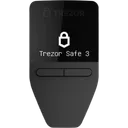
The Tangem Wallet uses a Samsung-manufactured secure element rated at CC EAL6+ — the highest certification level among consumer hardware wallets currently on the market. For comparison, the Ledger Nano X uses a ST33 secure element at CC EAL5+, and the Trezor Safe 3 uses an Infineon SLx9670 at CC EAL6+, making Tangem and Trezor Safe 3 tied at the top certification tier. The chip model is listed as "Tangem Secure Element" — a Samsung product customized for Tangem — but the exact Samsung part number is not publicly disclosed.
Firmware is closed source, with no reproducible builds and no open firmware option. Tangem states the firmware is signed and verified at boot via secure boot, but the signing authority is Tangem itself — no third-party audit of the signing infrastructure has been published. This is a meaningful trust assumption compared to Coldcard, whose firmware is open source and independently auditable.
Genuine device verification is supported: each card performs a cryptographic attestation using a key pair burned into the secure element at the Samsung factory. This is a hardware-level supply chain check, not just a software handshake — vendor claims this is unforgeable, and the mechanism is architecturally sound, though no independent red-team report has been published confirming it.
No publicly documented hardware attacks or CVEs exist for this device as of this writing. The absence of a screen eliminates certain attack surfaces (e.g., address substitution visible to user) but simultaneously removes the user's ability to verify transaction details on a trusted display — a significant security trade-off.
SecurityKey Factor
Tangem's recovery model is fundamentally different from every other hardware wallet in this comparison set. By default, no seed phrase is generated or shown to the user. The private key is generated inside the secure element and never leaves it — there is no BIP39 mnemonic to write down. This eliminates seed phrase theft as an attack vector, but it also means standard BIP39 recovery to a Ledger, Trezor, or any other wallet is impossible unless you explicitly enable the optional BIP39 seed export during setup.
The primary backup mechanism is multi-card backup using 2–3 physical cards. Each card in the set holds an identical key, so losing one card does not result in fund loss as long as another card survives. This is a proprietary backup model — it does not use Shamir Secret Sharing (SLIP39) and cannot be restored to non-Tangem devices without the optional seed.
Passphrase (BIP39 25th word) support is not available, which means there is no hidden wallet feature. This is a notable gap compared to Trezor Model T and Coldcard, both of which support passphrases natively.
If all cards in a set are lost simultaneously and no seed backup was created, funds are permanently unrecoverable. This is a binary risk that users must consciously accept. The optional BIP39 seed mode shifts the model closer to conventional wallets but reintroduces seed phrase exposure risk. Ledger and Trezor both default to 24-word BIP39 seeds, giving users immediate cross-device portability that Tangem does not provide by default.
Recovery & backups
Setup time is under 3 minutes: tap a card to an NFC-enabled phone, open the Tangem app, set a PIN, and the wallet is active. There are no buttons to press, no seed words to transcribe, and no firmware to update manually. This is the fastest onboarding of any hardware wallet currently rated on this site.
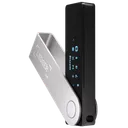
There is no screen on the device. All transaction details — recipient address, amount, network fee — are displayed exclusively on the companion smartphone app. This means transaction verification depends entirely on the security of the phone running the app, which is a weaker trust model than screen-equipped devices like the Ledger Nano X or Keystone 3 Pro.
Daily use workflow: open the Tangem app, initiate a send transaction, tap the card to the phone's NFC reader to sign. The NFC tap replaces button confirmation. It is fast and frictionless, but the lack of an on-device display means blind signing is a structural feature, not a bug — users cannot independently verify what they are signing without trusting the app.
The companion app is available on iOS and Android only — no desktop support for Linux, Windows, or macOS. This is a hard limitation for users who prefer desktop-based transaction management. Trezor Suite and Ledger Live both offer full desktop clients.
Learning curve is minimal for non-technical users. The card form factor (credit card size, 85×54×1 mm, 6 g) is intuitive. Advanced users who want address verification on a trusted display, passphrase support, or desktop integration will find the UX model restrictive.
Usability / UX
Tangem supports 85 networks and approximately 6,000 tokens through its native app. Key L1 chains include Bitcoin, Ethereum, Solana, BNB Chain, Polygon, Avalanche, and Tron. This network count is competitive with Ledger Live's ~50 natively supported chains (though Ledger extends further via third-party integrations).
Third-party wallet compatibility is limited. Tangem does not support MetaMask hardware wallet integration, Sparrow Wallet, Electrum, or any desktop wallet connector. There is no WalletConnect v2 integration built into the Tangem app as of this writing — vendor has indicated WalletConnect support is in development, but it is not currently available and should not be treated as a present feature.
DeFi and NFT interaction requires using the Tangem app's built-in browser or swap features, which are powered by third-party aggregators. This is a closed ecosystem approach: you cannot plug the card into MetaMask and interact with arbitrary dApps the way you can with a Ledger or Trezor connected via browser extension.
For Bitcoin specifically, there is no PSBT support, no Taproot address generation confirmed, and no compatibility with Sparrow or Specter Desktop — tools that power-users and multisig setups depend on. Coldcard and Passport are significantly ahead on Bitcoin-native tooling.
Ecosystem & integrations
No account registration is required to use the Tangem Wallet — the app functions without an email address or identity verification. This is a baseline privacy positive shared with Trezor and Coldcard.
The Tangem app collects analytics telemetry by default. An opt-out is available in app settings, but it is not presented prominently during onboarding. The specific data collected (device model, OS version, transaction counts, feature usage) is described in Tangem's privacy policy, but independent verification of what is actually transmitted has not been published.
The wallet has no Tor or built-in VPN support. All network requests from the app — including balance lookups and transaction broadcasts — go through Tangem's infrastructure or third-party node providers. Users cannot point the app at their own Bitcoin node or Electrum server, which is a significant privacy gap versus Coldcard (fully air-gapped, works with any node via PSBT) and Passport (supports custom Electrum server).
The device itself has no network connectivity — NFC only, no Bluetooth, no USB, no WiFi — so the card cannot leak data independently. All privacy risks originate from the smartphone app and its backend dependencies.
CoinJoin is not supported. There is no Whirlpool, JoinMarket, or Wasabi integration. For Bitcoin privacy, Coldcard paired with Sparrow remains the benchmark this device cannot approach.
Privacy
The Tangem Wallet 2-card set is priced at $54 USD. A 3-card set (recommended for better redundancy) costs $69. For direct comparison: the Ledger Nano S Plus is $79, the Trezor Model One is $69, and the Coldcard Mk4 is $147.94. Tangem is the lowest-cost entry point among hardware wallets with a CC EAL6+ secure element.
The value proposition is strongest for mobile-first users who hold diversified altcoin portfolios and want a simple, fast signing experience without managing seed phrases. The 6,000-token support and 85-network coverage at $54 is a competitive data point.
The value proposition weakens significantly for:
Bitcoin-focused users — no Sparrow/Electrum compatibility, no PSBT, no CoinJoin. A $69 Trezor Model One or $79 Ledger Nano S Plus offers better Bitcoin tooling integration.
Security researchers and advanced users — closed-source firmware with no reproducible builds is a hard blocker. Trezor's fully open-source stack at $69 is a better choice for auditability.
Users needing desktop access — no Windows, macOS, or Linux support eliminates Tangem for anyone managing funds from a computer.
Users who want passphrase/hidden wallet support — neither the 2-card nor 3-card set supports BIP39 passphrases, a feature available on every major competitor above $50.
At $54, Tangem is priced correctly for its target user: a non-technical mobile user who values simplicity over auditability and flexibility.
Price & value
The Tangem Wallet (2 cards) is a genuinely compelling option for mobile-first users who prioritize simplicity and durability, but its closed-source firmware and lack of a seed phrase by default make it a hard sell for security purists.
Buy this wallet if:
You are a crypto newcomer who wants a dead-simple, tap-to-use experience with no seed phrase to manage or lose — Tangem's card-based backup system handles recovery without the usual 24-word anxiety.
You live an active lifestyle and need a wallet that survives water, bending, and daily wear — the IP68-rated, 1mm-thin PVC card form factor is unlike anything else at the $54 price point.
You rely exclusively on a smartphone (iOS or Android) and want NFC-based signing across 85 networks and 6,000+ tokens without ever plugging in a cable.
Skip this wallet if:
You demand open-source, auditable firmware — Tangem's software is fully closed-source with no reproducible builds. Consider the Coldcard Mk4 ($149) or Foundation Passport ($199) for transparent, community-verified security.
You use a desktop computer for transaction management — Tangem has zero Windows, macOS, or Linux support. The Ledger Nano X ($149) covers all platforms and also supports mobile.
You need advanced features like multisig, coin control, or Shamir Secret Sharing for high-value storage — the Trezor Model T ($219) or Coldcard are far better suited for power users.
If choosing between Tangem and Ledger Nano S Plus ($79): The Nano S Plus wins on open ecosystem, desktop support, and community trust, but Tangem wins on physical durability and ease of onboarding for non-technical users.
If choosing between Tangem and Keystone 3 Pro ($149): Keystone offers a large display, QR-based air-gapped signing, and open-source firmware — meaningfully stronger security guarantees for nearly three times the price.
Tangem earns its place as a solid entry-level hardware wallet for mobile users who value convenience and ruggedness, but the closed firmware and no-display design are real trade-offs that should not be overlooked before committing your funds.
✓ Our Verdict
The Tangem Wallet (2 cards) is a genuinely compelling option for mobile-first users who prioritize simplicity and durability, but its closed-source firmware and lack of a seed phrase by default make it a hard sell for security purists.
Buy this wallet if:
You are a crypto newcomer who wants a dead-simple, tap-to-use experience with no seed phrase to manage or lose — Tangem's card-based backup system handles recovery without the usual 24-word anxiety.
You live an active lifestyle and need a wallet that survives water, bending, and daily wear — the IP68-rated, 1mm-thin PVC card form factor is unlike anything else at the $54 price point.
You rely exclusively on a smartphone (iOS or Android) and want NFC-based signing across 85 networks and 6,000+ tokens without ever plugging in a cable.
Skip this wallet if:
You demand open-source, auditable firmware — Tangem's software is fully closed-source with no reproducible builds. Consider the Coldcard Mk4 ($149) or Foundation Passport ($199) for transparent, community-verified security.
You use a desktop computer for transaction management — Tangem has zero Windows, macOS, or Linux support. The Ledger Nano X ($149) covers all platforms and also supports mobile.
You need advanced features like multisig, coin control, or Shamir Secret Sharing for high-value storage — the Trezor Model T ($219) or Coldcard are far better suited for power users.
If choosing between Tangem and Ledger Nano S Plus ($79): The Nano S Plus wins on open ecosystem, desktop support, and community trust, but Tangem wins on physical durability and ease of onboarding for non-technical users.
If choosing between Tangem and Keystone 3 Pro ($149): Keystone offers a large display, QR-based air-gapped signing, and open-source firmware — meaningfully stronger security guarantees for nearly three times the price.
Tangem earns its place as a solid entry-level hardware wallet for mobile users who value convenience and ruggedness, but the closed firmware and no-display design are real trade-offs that should not be overlooked before committing your funds.
Ready to buyTangem Wallet (2 Cards)?
We may earn a commission if you purchase through our links. This doesn't affect our editorial independence.
Impermanent loss happens when asset prices in a liquidity pool diverge from external markets, reducing the value of liquidity providers' holdings compared to simply holding the assets.
Tangem is a hardware wallet in the form of a physical card that stores cryptocurrency private keys securely and offline, allowing for easy and portable access to digital assets.
EAL Certification (Evaluation Assurance Level) from Common Criteria rates the security of hardware components, like secure chips in crypto hardware wallets. Higher levels, such as EAL5+ or EAL6+, indicate stronger resistance to attacks.
Reproducible Builds refer to the process where the same source code consistently produces identical binary outputs, ensuring verifiable and trustworthy software in blockchain and crypto projects.
Open Source Firmware refers to firmware in hardware devices, like wallets, where the source code is publicly available, allowing transparency, auditability, and customization.
Secure Boot is a security feature that ensures only trusted software runs on a device by verifying its integrity during startup, preventing unauthorized code execution in crypto systems.
Coldcard is an air-gapped hardware wallet for Bitcoin, made by Coinkite, that stores private keys offline and signs transactions without internet exposure.
Firmware Attestation is the process of verifying the authenticity of a device's firmware to ensure it has not been tampered with, commonly used in hardware wallets for security.
Recovery is the process of restoring access to a cryptocurrency wallet using its seed phrase or mnemonic backup if the original wallet is lost or inaccessible.
BIP39 is a standard for generating mnemonic seed phrases that are used to create deterministic wallets and securely back up cryptocurrency private keys.
A backup in cryptocurrency is a secure copy of a wallet's seed phrase or private keys. It enables recovery of funds if the original wallet is lost or damaged.
Shamir Secret Sharing (SSS) divides a secret, like a crypto wallet seed, into multiple shares. A threshold number of shares reconstructs it, enhancing security as in SLIP-39 backups.
A passphrase is an additional security layer for cryptocurrency wallets, acting as a 25th word in the BIP39 seed phrase, protecting access to hidden wallets.
A hidden wallet conceals a secondary cryptocurrency wallet behind an additional passphrase on the same seed, providing plausible deniability against coercion.
A transaction fee is a cost paid to process transactions on a blockchain network. It compensates miners or validators for confirming and adding transactions to the blockchain.
A block confirmation is the process of verifying a new block in the blockchain network, confirming its validity and preventing double-spending or fraud.
A companion app is a software application used to manage and interact with cryptocurrency wallets or blockchain networks, typically offering features like transactions and security controls.
Ledger Live is a software application that manages cryptocurrency assets and interacts with Ledger hardware wallets for secure transactions and portfolio management.
Address Verification confirms the receiving address shown on a hardware wallet's screen matches the one on the computer or app, preventing malware from altering it.
Bitcoin (BTC) is the first decentralized cryptocurrency, launched in 2009. It uses blockchain technology for secure, peer-to-peer digital transactions without intermediaries.
Ethereum is a decentralized blockchain platform that enables smart contracts and decentralized applications (dApps). Its native cryptocurrency is Ether (ETH).
Solana is a high-performance layer-1 blockchain platform that enables fast, low-cost transactions using Proof of History and Proof of Stake. Its native token is SOL.
BNB Chain is a high-performance blockchain network developed by Binance, formerly Binance Smart Chain (BSC). It supports smart contracts, DeFi, and uses BNB as its native token.
Polygon is a layer-2 scaling solution for Ethereum that enables faster, cheaper transactions via its Proof-of-Stake sidechain. Native token: MATIC (also called Polygon PoS).
Avalanche (AVAX) is a scalable layer-1 blockchain platform that achieves high throughput and sub-second transaction finality using its novel proof-of-stake consensus.
TRON is a blockchain platform and cryptocurrency (TRX) designed for high-throughput decentralized applications, especially in content sharing and entertainment.
Electrum is a lightweight Bitcoin wallet that allows users to store, send, and receive Bitcoin securely. It is known for its speed and low resource usage.
WalletConnect is a protocol that enables secure communication between decentralized applications (dApps) and mobile wallets through QR code scanning or deep linking.
DeFi (Decentralized Finance) refers to a set of financial services, such as lending and trading, built on blockchain technology without traditional intermediaries like banks.
An NFT (Non-Fungible Token) is a unique digital asset stored on a blockchain, representing ownership of a specific item, such as artwork, music, or virtual goods.
In cryptocurrency, a swap is the direct exchange of one token for another on a blockchain, often via decentralized exchanges (DEXs) without intermediaries.
PSBT (Partially Signed Bitcoin Transaction) is a Bitcoin transaction format that allows multiple parties to sign a transaction incrementally before finalizing it.
Taproot (BIP 341) is a Bitcoin upgrade that introduces Schnorr signatures and Tapscript, enhancing privacy by making complex scripts look like simple payments and improving efficiency.
Specter is a Bitcoin hardware wallet solution designed for advanced users, offering secure storage through a customizable, self-hosted setup with options like Specter Desktop and Specter DIY.
Multisig (multi-signature) is a security feature that requires multiple private keys to authorize a transaction, enhancing protection against unauthorized access in blockchain networks.
KYC (Know Your Customer) is the regulatory process where cryptocurrency exchanges verify users' identities using documents like ID or proof of address to prevent fraud and money laundering.
Telemetry in cryptocurrency and blockchain refers to the automatic collection and transmission of anonymous usage data, metrics, and error reports from wallets or nodes to improve software.
A Full Node is a computer that stores the entire blockchain and verifies all transactions, ensuring network security and consistency in cryptocurrency systems like Bitcoin.
CoinJoin is a privacy technique in cryptocurrency where multiple users combine their transactions, making it harder to trace individual senders and receivers.
HODL is cryptocurrency slang for holding assets long-term despite price volatility, rather than selling. It originated from a 2013 forum post misspelling 'hold' as 'I AM HODLING.'
Cryptocurrency is a digital or virtual currency secured by cryptography, operating on decentralized blockchain networks to enable secure, peer-to-peer transactions.
Coin Control is a feature that allows users to manually select which unspent transaction outputs (UTXOs) to use in a transaction, giving more control over privacy and fees.
Offline Signing refers to signing cryptocurrency transactions on a device that is not connected to the internet, ensuring private keys remain secure from online threats.
Tangem Wallet (2 Cards) uses a certified Secure Element chip to store private keys in tamper-resistant hardware. Even if the device's software were compromised, the Secure Element isolates your keys from extraction. The firmware is open-source, meaning security researchers worldwide can audit the code for vulnerabilities. The device has been independently security audited.
What if Tangem goes out of business?
Tangem's firmware is open-source — even if the company disappears, the community can maintain the software. Your seed phrase works with any BIP39-compatible wallet, so your funds are always recoverable.
What if I lose my Tangem Wallet (2 Cards)?
Your cryptocurrency is stored on the blockchain, not on the device. If you lose your Tangem Wallet (2 Cards), you can recover full access using your seed phrase on any compatible wallet. Multiple backup cards are supported for redundant recovery.
How long will Tangem Wallet (2 Cards) receive security updates?
Tangem Wallet (2 cards) is built around a Samsung-manufactured Secure Element rated CC EAL6+, one of the highest hardware security certifications available in consumer devices. Each card features secure boot and a genuine-check mechanism to prevent tampering. However, there are notable trade-offs: the firmware is not open source, reproducible builds are not supported, and passphrase (BIP39) support is disabled by default. For users comfortable with a closed-source model and who prioritize physical simplicity over auditability, it is a solid choice. Advanced users who demand full transparency may prefer alternatives.
Is Tangem Wallet (2 cards) worth it for the price?
At $54 for two cards, Tangem Wallet (2 cards) is one of the most affordable hardware wallets with a certified Secure Element. You get NFC-based signing, IP68 water resistance, support for 85+ networks and 6,000+ tokens, and a built-in multi-card backup system — all without a battery or screen. If you value simplicity and portability over advanced features like coin control or multisig, the price-to-security ratio is excellent. Power users needing a display, offline signing, or open-source firmware will find the value proposition weaker.
Tangem Wallet (2 cards) vs Ledger Nano S Plus: which is better?
These wallets target different users:
Tangem (2 cards): NFC-only, no screen, no USB, card-form-factor, IP68 rated, no seed phrase by default, $54.
Ledger Nano S Plus: USB-C, small display, seed phrase recovery, open Ledger Live ecosystem, ~$79.
Tangem wins on portability, water resistance, and ease of use. Ledger wins on display-verified transaction signing, open-source app layer, and broader advanced features. If you want a dead-simple tap-to-sign experience, choose Tangem. If you want a screen for transaction verification and a mature software ecosystem, choose Ledger.
How many coins and networks does Tangem Wallet (2 cards) support?
Tangem Wallet (2 cards) supports 85 blockchain networks and over 6,000 tokens through the Tangem mobile app, available on iOS and Android. Major networks include Bitcoin, Ethereum, BNB Chain, Solana, Polygon, and many EVM-compatible chains. Note that there is no desktop support — Windows, macOS, and Linux are not compatible. All interactions happen via NFC tap with your smartphone; there is no USB, Bluetooth, or QR code connectivity.
Does Tangem Wallet (2 cards) have a seed phrase, and what happens if I lose a card?
By default, Tangem Wallet generates keys directly on the card with no seed phrase, which eliminates seed phrase theft risk but changes the recovery model entirely. Recovery relies on the second card in the set, which acts as a backup. You can optionally enable BIP39 seed phrase generation if you prefer traditional recovery. If you lose one card and have no backup card and no seed phrase enabled, your funds are unrecoverable. Tangem strongly recommends using both cards and storing them separately for this reason.
Is Tangem a trustworthy company, and are there any known vulnerabilities?
Tangem is a Swiss-based company founded in 2017 with cards manufactured using Samsung Secure Elements. In late 2022, a serious vulnerability was disclosed: the Tangem app was logging seed phrases in email crash reports, which could expose them to Tangem's servers. The company patched this quickly, but it highlighted risks tied to the closed-source nature of the software. The firmware itself has not been independently audited publicly. Users should keep the app updated and be aware that closed-source software limits community verification of security claims.
Can Tangem Wallet (2 cards) be used without a phone or internet connection?
Tangem Wallet (2 cards) requires a smartphone with NFC to operate — it has no screen, no USB port, no Bluetooth, and no battery of its own. Transaction signing happens on the card, but broadcasting requires the Tangem app and an internet connection. Offline signing is not supported. This means the wallet cannot function as a fully air-gapped device. If your phone is unavailable or the Tangem app is discontinued, access to your funds depends on whether you have a seed phrase backup enabled or a compatible third-party wallet that supports Tangem cards.
Some links on this page are affiliate links. If you purchase through them, I may earn a commission at no additional cost to you. This helps support the site and allows me to continue creating detailed, independent reviews.
Our testing methodology is evolving. Ratings and assessments will be refined as we improve our scoring framework to reflect the most accurate results.
Ready to get Tangem Wallet (2 Cards)?
Long-term support • Secure Element • Security audited • NFC • Open source